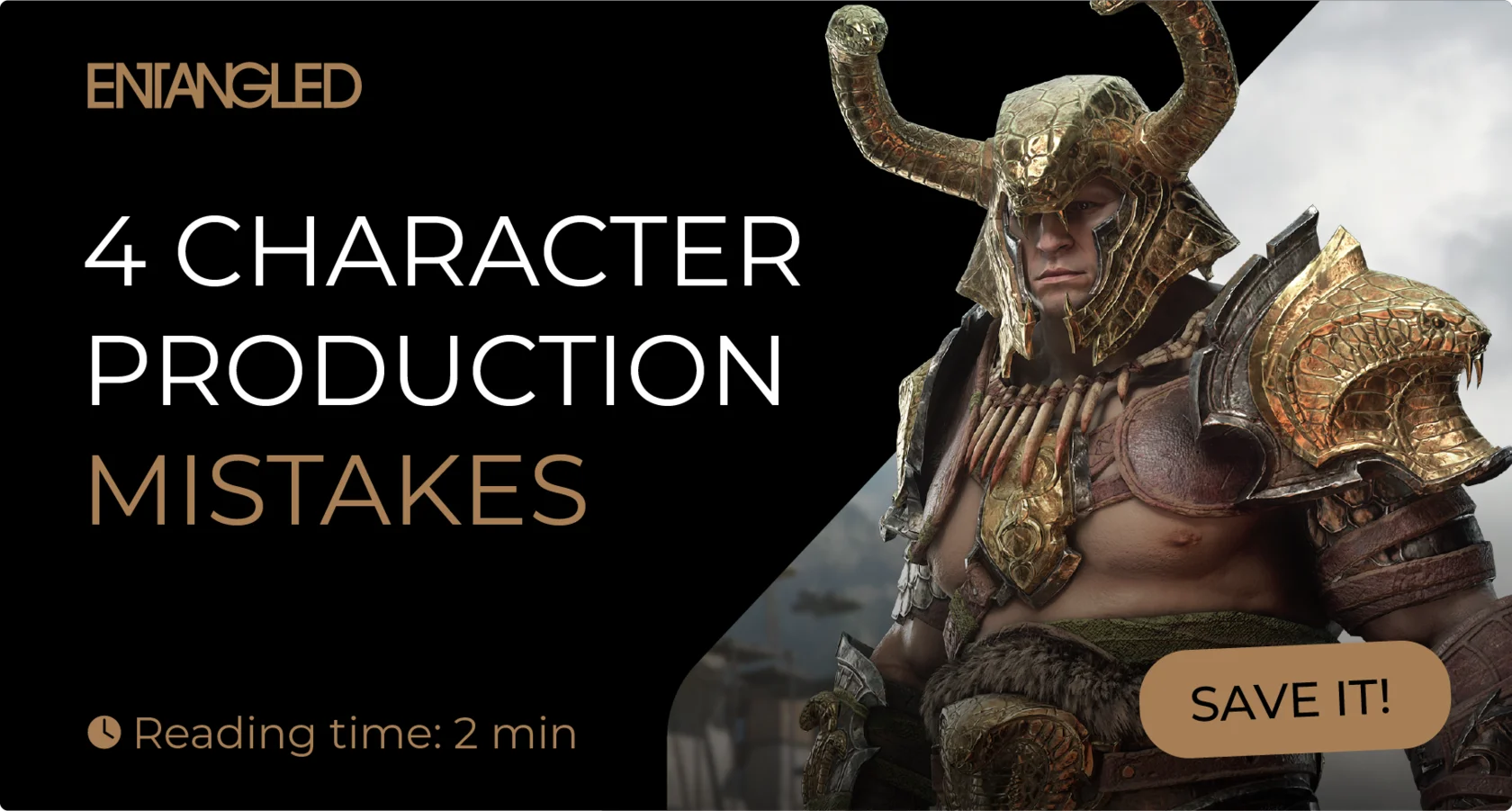
After working on character production across dozens of AAA projects, we noticed a pattern: the most common sources of rework aren't about artistic quality. They're about process. Specifically, a few decisions that seem reasonable at the start — until they quietly derail the pipeline down the line.
We put together four of the most frequent ones, along with how we handle them at ENTANGLED Studio.
1. No quality bar defined before production starts
If there's no shared understanding of what "done" looks like, every delivery becomes a guessing game. Assets arrive in unclear states, feedback rounds multiply, and you end up paying for work that has to be redone.
Before production begins, we align on quality standards: what gets reviewed, at what stage, and by whom. Every asset goes through internal art direction and QA checks before it reaches the client — only work we're confident in gets submitted. For teams newer to external development, our leads can also help set up documentation, process, and creative direction from day one.
2. Detailing without optimization in mind
A lot of beautiful detail gets created at Stage 1 — only to be cut later because it doesn't fit technical constraints. The result is wasted time and budget on work that was never going to survive into production.
We treat Stage 1 as the point where optimization begins, not ends. Our artists and tech team work together from the start: when building a character, we're already thinking about engine performance, movement, and cloth simulation during animation. Technical risks get identified early so that decisions at Stage 1 account for every stage that follows.
3. No acceptance criteria before production starts
"We'll know it when we see it" is one of the most reliable ways to generate extra revision rounds. Without agreed criteria upfront, every delivery opens up a new negotiation.
Our recommendation: build a detailed reference board and set benchmarks before any production begins. Align on the expected result as precisely as possible — and do it early. The more specific the brief, the fewer surprises on both sides.
4. Feedback filtered through too many hands
It's rarely a communication problem in the obvious sense. More often it's the telephone effect: notes pass from producer to lead to artist, and meaning shifts along the way. The result is extra iterations, slower delivery, and outcomes that don't match the original intent.
On every project, we have a lead and a department lead managing internal communication, QA, and documentation — so clients don't need to spend time managing us. If you prefer direct access to the team, we're open to that too. At ENTANGLED, communication is a team responsibility, not just the producer's job.
These four points come up again and again across projects of all sizes. If you're building out or scaling a character production pipeline and want to talk through your setup, we're happy to dig into the details.
Our character art capabilities cover the full range: heroes, villains, creatures, beasts, weapons, armor, and everything in between. Browse the portfolio on ArtStation, book a sync in our calendar, or reach out at bd@entgld.com.
We put together four of the most frequent ones, along with how we handle them at ENTANGLED Studio.
1. No quality bar defined before production starts
If there's no shared understanding of what "done" looks like, every delivery becomes a guessing game. Assets arrive in unclear states, feedback rounds multiply, and you end up paying for work that has to be redone.
Before production begins, we align on quality standards: what gets reviewed, at what stage, and by whom. Every asset goes through internal art direction and QA checks before it reaches the client — only work we're confident in gets submitted. For teams newer to external development, our leads can also help set up documentation, process, and creative direction from day one.
2. Detailing without optimization in mind
A lot of beautiful detail gets created at Stage 1 — only to be cut later because it doesn't fit technical constraints. The result is wasted time and budget on work that was never going to survive into production.
We treat Stage 1 as the point where optimization begins, not ends. Our artists and tech team work together from the start: when building a character, we're already thinking about engine performance, movement, and cloth simulation during animation. Technical risks get identified early so that decisions at Stage 1 account for every stage that follows.
3. No acceptance criteria before production starts
"We'll know it when we see it" is one of the most reliable ways to generate extra revision rounds. Without agreed criteria upfront, every delivery opens up a new negotiation.
Our recommendation: build a detailed reference board and set benchmarks before any production begins. Align on the expected result as precisely as possible — and do it early. The more specific the brief, the fewer surprises on both sides.
4. Feedback filtered through too many hands
It's rarely a communication problem in the obvious sense. More often it's the telephone effect: notes pass from producer to lead to artist, and meaning shifts along the way. The result is extra iterations, slower delivery, and outcomes that don't match the original intent.
On every project, we have a lead and a department lead managing internal communication, QA, and documentation — so clients don't need to spend time managing us. If you prefer direct access to the team, we're open to that too. At ENTANGLED, communication is a team responsibility, not just the producer's job.
These four points come up again and again across projects of all sizes. If you're building out or scaling a character production pipeline and want to talk through your setup, we're happy to dig into the details.
Our character art capabilities cover the full range: heroes, villains, creatures, beasts, weapons, armor, and everything in between. Browse the portfolio on ArtStation, book a sync in our calendar, or reach out at bd@entgld.com.